Confluence referendum push begins, but it might not be legal
Tom Giffey, photos by Nick Meyer |
Eau Claire residents may get a chance to vote in a referendum about the proposed Confluence Project. Or maybe they won’t. A petition drive will soon begin to put a public referendum on the ballot, but legal questions remain, and even if that referendum passes, it would require another referendum in which city voters would weigh in on financial support for the proposed arts center-mixed use facility in downtown Eau Claire.
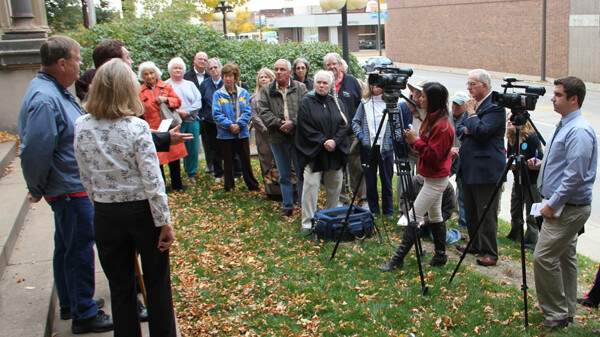
Businessman (and former school board member) Mike Bollinger announced Wednesday that his group would begin to collect signatures on a petition to force a referendum vote. Under state law, they must collect John Hancocks from 3,619 eligible city voters to get the referendum on the ballot. Bollinger and his committee said in October that they weren’t necessarily opposed to the Confluence Project, but that they believed citizens – not just City Council members – should decide on public funding for the project. However, the City Council subsequently declined to hold a referendum and conditionally pledged $5 million toward the project. The majority of council members agreed that the citizens already had provided extensive input on the issue and that the financial complexity of the issue made it too complicated to address in a simple “yes or no” referendum question.
“Given the current City Council’s reluctance to place any sort of referendum in front of the people of this city, the petition insures that projects of this type of construction will require a binding vote of the citizenry in the future,” Bollinger said in an email announcing the petition effort. Once it begins, organizers have 60 days to collect signatures.
However, City Attorney Stephen Nick told the Leader-Telegram that the proposed binding referendum wouldn’t be legally eligible for the ballot. In part, that’s because binding referendums must be narrow in scope (and this one would potentially impact publicly funded efforts beyond the Confluence Project) and can’t overturn previous City Council actions (in this case, the $5 million pledge). “In its current format, it’s not a proper subject of direct legislation,” Nick told the newspaper.
The proposed referendum would enact an ordinance requiring “that certain building projects constructed with funds of the city or a city entity shall be submitted to referendum prior to construction.” Specifically, these projects would be those involving buildings for “dramatic, musical, or athletic artistic performances” that would cost the city $1 million or more, as well as projects that would destroy nationally or city designated landmarks*. In essence, if this referendum were to pass – and be upheld as legal – a second referendum would be required to allow city funding for the Confluence to move forward.
Confluence supporters and their City Council allies argued that such a referendum is unneeded and would unnecessarily delay the project, a roughly $80 million public-private partnership involving UW-Eau Claire, the Eau Claire Regional Arts Council, and Commonweal Development.
* The pro-referendum committee announced Thursday it had dropped the landmark-related wording from the proposed referendum, in part to address the city's legal concerns. The new wording also exchanged "athletic" for "artistic."