Take A Self-Guided Tour Through 15 Of Menomonie's Newest Murals
thanks to the Dunn County Historical Society, locals and visitors now have a complete roadmap to view artwork from the Walldogs' colorful 'Murals In Menomonie' project
Evelyn Nelson, photos by Andrea Paulseth |

For one week in June, locals in Menomonie got to know the “Walldogs,” an international-spanning collective of sign painters and muralists who specialize in hand-painted, historical murals.
The “Murals In Menomonie” public art project brought hundreds of Walldogs artists from around the country – and right here in our neck of the woods – together to create 15 murals which tell notable stories of the Menomonie area.
From lumber and cigar industries of the late 1800s, farming and agriculture landscapes which shaped its local food systems – even crime and high-speed car chases through its downtown – each mural and its design pays homage to stories of the city not always found in textbooks.
Locals were encouraged to visit with the muralists and see the creation process up close from June 24-28 and attend the Murals in Menomonie art auction and gala held on June 27.
The expansive project – nearly three years and $300,000 in the making – was funded through donations and sponsorships contributed by locals, businesses and property owners, including the Menomonie Area Chamber & Visitor Center, City of Menomonie and Vintage Sign Shop, among others.
Now, thanks to the Discover Dunn County app – produced by the Rassbach Museum (1820 John Russell Rd, Menomonie) – anyone can embark on a journey through all finished installations and uncover the historic narratives embedded in each brushstroke.
We’ve compiled a snapshot of historical facts from a handful of those murals, to get folks thinking about what places and spaces they have yet to learn about in the Chippewa Valley. See that down below:
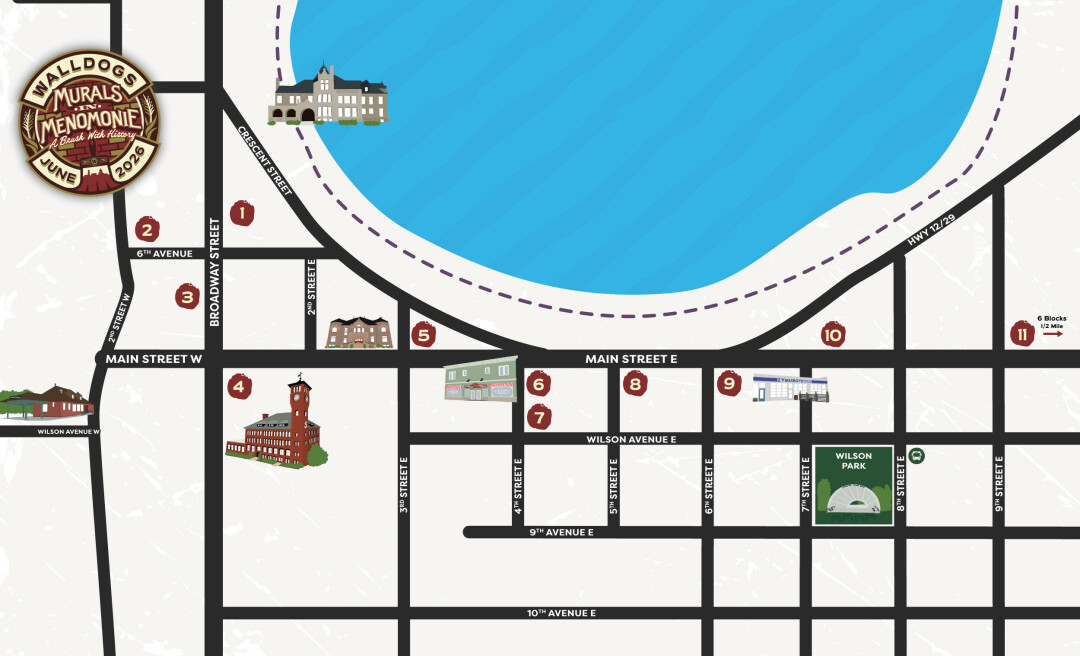
A history lesson from the 2026 Murals In Menomonie
Information sourced from the Dunn County Historical Society and Rassbach MuseumKraft State Bank
Location: BMO Bank N.A. Branch - the Hintzman building (438 5th St. E, Menomonie)
Oct. 20, 1931, four men – Frank Webber, Charles Preston Harmon, Frances Keating, and Tommy Holden – came to a stop on the 400 block of Main Street in Menomonie in a 1928 Phaeton Model L Lincoln. Webber stayed at the wheel and the other three men jumped out of the car. They walked to the Kraft State Bank, drew their guns and rushed into the lobby. The robbers scooped up more than $90,000 in cash and securities – an amount worth more than a million dollars today. That was the start of an ill-fated day, with horrific crime, a high-speed car-chase and mysterious disappearance, that left a lasting mark on Menomonie.
Menomonie's History
Location: 614 Main St. E, Menomonie
Menomonie Brick Company: The Menomonie Brick Company was a historical brick manufacturer here in Menomonie. It operated two yards at one time. One of its yards was located on the site now occupied by the Wisconsin Department of Natural Resources offices, at the intersection of State Highway 29 and County Highway P.
Wild Rice: Menomonie gets its name from the Ojibwe word for wild rice, manoomin. The area around Menomonie had extensive wild rice stands, which were destroyed when Lake Menomin was created.
Lumber: The land now known as Dunn County was rich in White Pine, attracting the lumber industry in the mid 1800’s. Due to extensive logging, mostly by the Knapp Stout and Co. Lumber Company, the timber was mostly gone by 1900. Despite its short tenure the lumber industry – and the lumberjacks who worked the land–play a major role in the story of Dunn County.
The Golden Submarine
Location: Auto Value Menomonie (709 Main St. E, Menomonie)
Born on Dec. 9, 1875, in Menomonie, Harry Miller would go on to become one of the most influential and revolutionary figures in the early days of American motorsports. Cars built by Miller won 73 of the 92 major U.S. races from 1922 through 1929. Miller partnered with Barney Oldfield to develop a racing machine that would not only be fast and durable, but that would also protect the driver in the event of an accident. The result was known as the Golden Submarine, the first race car to incorporate an enclosed roll cage inside a streamlined driver's compartment to completely enclose the driver. The Golden Submarine was built from aluminum with holes for the driver to look out. The gold color was achieved with a combination of bronze dust and lacquer. The car cost $US 15,000 to build ($368,000 in 2025).
Anderson Cigar Company
Location: Adoray’s Treasures from the Heart (521 6th Ave. E, Menomonie)*
In 1893, Otto and Al Anderson, Swedish-born brothers, purchased the Diamond Cigar Company in Menomonie. They expanded the business, building a new factory on the bank of Lake Menomin, at the intersection of West Crescent, Main and Fourth Streets. The Anderson Cigar Company, as it became known, was a significant part of Menomonie's history, and operated for many years. Hand-rolled cigars played a big role in Menomonie's history, with numerous cigar companies operating in the late 1800s and early 1900s. Anderson Cigar Company would go on to be the largest cigar factory in northern Wisconsin, producing over two million cigars annually in its busiest years.
*This mural will be installed later this August, following building preparations for the mural.
Learn more about the 2026 Murals In Menomonie project, a Walldogs collective effort, through Volume One coverage online. For instructions to download the Discover Dunn County app – for Android, Apple and desktop devices – visit www.dunnhistory.org/discoverdunnapp.